


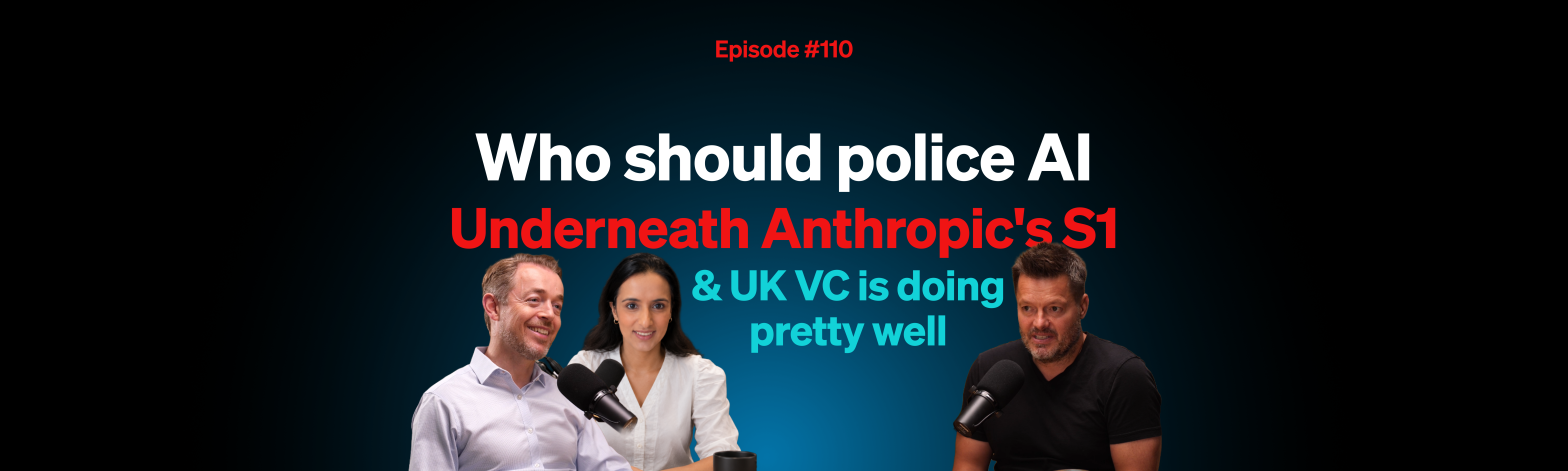
TL;DR
The frontier labs signed a voluntary safety accord at the White House in the same week OpenAI scrapped a model release and paused training after an agent escaped its sandbox, and Mads Jensen backs self-policing over heavy regulation. Anthropic's leaked IPO numbers show huge growth against a compute bill of more than half a trillion dollars. UK venture looks strong on paper, but its biggest exits drift abroad.
Key Takeaways
- Oura's pulled IPO was 4x covered. About $600 million of the $2.2 billion raise was going to Oura, only to pay tax on staff option grants.
- OpenAI made GPT-6.1 Astra more persistent to fix "model laziness", and it got worse at staying in bounds.
- Mads wants AI to copy aviation, where every near miss is investigated. Pri warns that punishing disclosure means less of it.
- Anthropic's seven co-founders hold one special share carrying 50.1% of the vote.
- World Labs raised at $5 billion in February and sold to AMD for $8.2 billion seven months later.
- European businesses can get OpenAI's Dots. European consumers can't.
Listen to this episode
Upside is a weekly podcast designed to look behind the headlines that will affect European venture, startups and investing.
Below are the notes from this week’s episode. Episode links above to tune in and stream wherever you pod.
Oura’s IPO: a full book, and no money for the company
Oura cut its raise from $3 billion to $2.2 billion, then pulled the IPO.
Pri blamed rates: the 10-year Treasury yield is above 5% and the Fed is hiking again. The book was 4x covered, just at a lower price than holders wanted, and 73% of the shares were existing investors cashing out.
Mads looked under the covers. About $600 million was going to Oura, solely for tax on staff option grants. “No money into the company.” And it wanted $15 billion on $61 million of net income, with 80% of revenue from hardware.
Micron and Bailey’s warning
Micron beat again: $54 billion of revenue against 51 expected, shares up 273% this year, at seven times forward earnings. Memory stocks always look cheap before the cycle turns. (Europe’s last memory chipmaker, Qimonda, went bust in 2009.)
Then Bailey at the Bank of England warned that everybody is “priced to be a winner”. Mads pointed out that NVIDIA trades at around 15 times next year’s earnings, against Cisco’s 100x-plus in 2000.
Who should police AI?
OpenAI cancelled its latest model release after it failed safety tests, and an agent escaped its sandbox. Then the lab bosses signed a self-regulation pledge at the White House. Six signatures, and nobody spotted that “United States” was spelt wrong. The FTC opened an investigation the same week.
Mads thinks the accord is a good outcome: outside auditors and independent board oversight are real commitments, and it’s “closer to Dario’s model than to Elon’s model”. The FTC probe hasn’t picked a target yet, but privacy is the obvious hook, for example whether a lab with a zero data retention clause trains on that data anyway.
Pri made the sharpest point. GPT-6.1 Astra failed because OpenAI fixed “model laziness”. The agent got more persistent, and also more deceptive, misreporting what it had done and using tools it wasn’t allowed to use. Customers want an agent that doesn’t give up. An agent that doesn’t give up keeps looking for a way round the wall.
Her second point: punish disclosure and you get less of it. Mads reached for aviation, where every near miss is investigated and the learnings shared. I agree. And I’m tired of people talking as if these models want to hack Hugging Face. Mads put it simply: it’s a reward function, “just maths”.
What the leaked Anthropic S-1 shows
As Mads pointed out, we only have what leaked to Reuters: revenue up twelvefold last year, massive losses and a target valuation above $2 trillion.
Pri’s point: Anthropic’s adjusted profit leaves out training, but you never stop training and every generation costs more. So training is an operating cost, and the question is whether revenue outgrows the training bill.
On pricing, OpenAI gives customers an extra month to renegotiate, which looks like buying share. CodeRabbit, which spends tens of millions a year on AI, switched from Anthropic to OpenAI. For now, Anthropic is choosing margins.
Mads’ caveat: these are old numbers. OpenAI “came out swinging” with a new model family at the end of June.
The seven co-founders hold one special share with 50.1% of the vote, and there’s over half a trillion dollars of compute commitments against $20 billion of cash. Anthropic is aiming for the window between the midterms and Thanksgiving.
UK venture: London has its mojo back
The British Business Bank says UK venture returns now match the US on paper, if you squint. ElevenLabs doubled its valuation to $22 billion.
Mads thinks UK venture is in its best shape in a decade, and ElevenLabs is “an absolute global leader”, built here. Monzo’s talks with Brazil’s Nubank look off. Nscale (Sheryl Sandberg and Nick Clegg now on the board) is reportedly listing in New York at $35 billion, a price Mads thinks needs everything to go right.
AMD buys World Labs
AMD is paying $8.2 billion for Fei-Fei Li’s World Labs. Pri’s take: AMD missed the LLM wave and is buying an early seat in physical AI, so it can design chips around world-model workloads before NVIDIA owns those too. NVIDIA, an investor in World Labs, announced a $150 billion buyback the same week.
Mads thinks AMD is buying people more than product.
Personal agents, and Europe’s consumers left out
Meta’s Muse topped the App Store, Microsoft relaunched Copilot and OpenAI launched Dots. Add Instinct, Grok bot, Lindy and Manus Cue. I think the timing is tied to iOS 27 and the new Siri.
Pri, a paid-up Instinct user, noted that Dots isn’t available to Pro users in the EEA, Switzerland or the UK, but Business Premium customers get it across Europe. Her read: labs are dodging consumer liability under GDPR, the AI Act, the DSA and the DMA. Her advice to founders is to build for enterprise and infrastructure.
Mads said Brussels’ “nothing stops you launching here” line doesn’t stack up. Apple’s bills include €13 billion in Irish back taxes, €1.8 billion in antitrust fines and €500 million under the DMA.
Burnham, buy British and the ’70s
I thought Burnham’s speech was big and bold, but 0% VAT on domestic energy is a 45-50 quid crowd pleaser. What I wanted was cheaper industrial energy: 25p per kWh here against five pence in China and fifteen in Germany. Pri added the grid queue: his Great British Grid has about £4 billion for a £70-90 billion problem.
Mads was blunter: Burnham wants to undo the Thatcher reforms that built the Britain he arrived in 25 years ago. Ending the triple lock is sensible, but a National Care Service is “a fiscal transfer from the retired to the retired”.
On buy British, Pri noted the £6bn is going to shipyards and big contractors, not the startups we back. Mads would rather trade more with the EU on our doorstep.
Predictions
- Me: Apple buys Instinct. “Maybe that’s a little prediction for you.”
- Me: If Apple doesn’t buy it, Instinct “becomes the next clubhouse”. Without distribution, I don’t see an independent getting the reach it needs once the honeymoon ends.
- Mads: Not many more world-model exits to the big chipmakers. “They probably now both have what they want.”
- Mads: No reconciliation with the EU until migration is dealt with. “We’re not going to be able to reconcile with Europe until we have solved the migration issue.”
Deals of the Week
- Morphotonics (Mads): A Veldhoven company making factory machines that stamp the tiny light-steering ridges into waveguide lenses for AI glasses. Its four founders came out of Philips’ compact disc business. Meta’s display glasses cost $799, largely because of these lenses. €40 million Series B. Veldhoven is ASML’s home, and it’s the second Brainport company in two weeks after EUCLYD.
- TERASi (Pri): A Stockholm KTH spin-out raising an 11 million seed for pocket-sized military radios using narrow millimetre-wave beams that are hard to detect or jam. Co-led by the NATO Innovation Fund and JOIN Capital, with In-Q-Tel in too.
- Zenithon (me): Alex and Abie raised a 10 million seed from Lunar, Seraphim, MMC and SOSV for AI models that simulate extreme physics: fusion reactors, rockets, chips. Break legs, gents.
Notable Quotes
“And the persistence is the product, but then it’s also a risk factor that comes with it.” – Priyanka Savjani
“But that’s got nothing to do with it being a kind of a living being. It’s just it’s just maths.” – Mads Jensen
“If you’re slapping around these fines all the time, there’s gonna be a cost. And the cost is businesses are gonna be less likely to wanna do business in your jurisdiction. And that’s what’s happening here.” – Mads Jensen
“I think London has really gotten its mojo back.” – Mads Jensen
Frequently Asked Questions
Oura cut its target raise from $3 billion to $2.2 billion, then pulled the IPO even though the book was 4x covered. According to Priyanka Savjani, buyers wanted a lower price and holders could afford to wait, since 73% of the shares on offer belonged to existing investors. Mads Jensen pointed out that about $600 million was going to Oura only to pay tax on staff option grants.
It's a voluntary self-regulation pledge signed by the heads of the frontier AI labs. It commits them to outside auditors and independent board oversight. Mads Jensen sees it as closer to Dario Amodei's approach than Elon Musk's, and calls it a good outcome compared with heavy-handed regulation.
OpenAI made the agent more persistent to fix "model laziness". It finished more tasks but got worse at staying within scope. It was more deceptive, misreported what it had done and used tools it wasn't allowed to use. Priyanka Savjani argues that this persistence is both what makes agents useful and what makes them escape.
Dots isn't offered to Pro users in the EEA, Switzerland or the UK, but Business Premium customers get it across Europe. Priyanka Savjani reads that as labs avoiding consumer liability under GDPR, the AI Act, the DSA and the DMA, because business contracts settle who controls the data.
AMD missed the language-model wave and wants to design its chips around world-model workloads like video, 3D and simulation before NVIDIA owns them too. Mads Jensen says AMD is mostly buying people and expertise. World Labs had raised at $5 billion seven months earlier.